
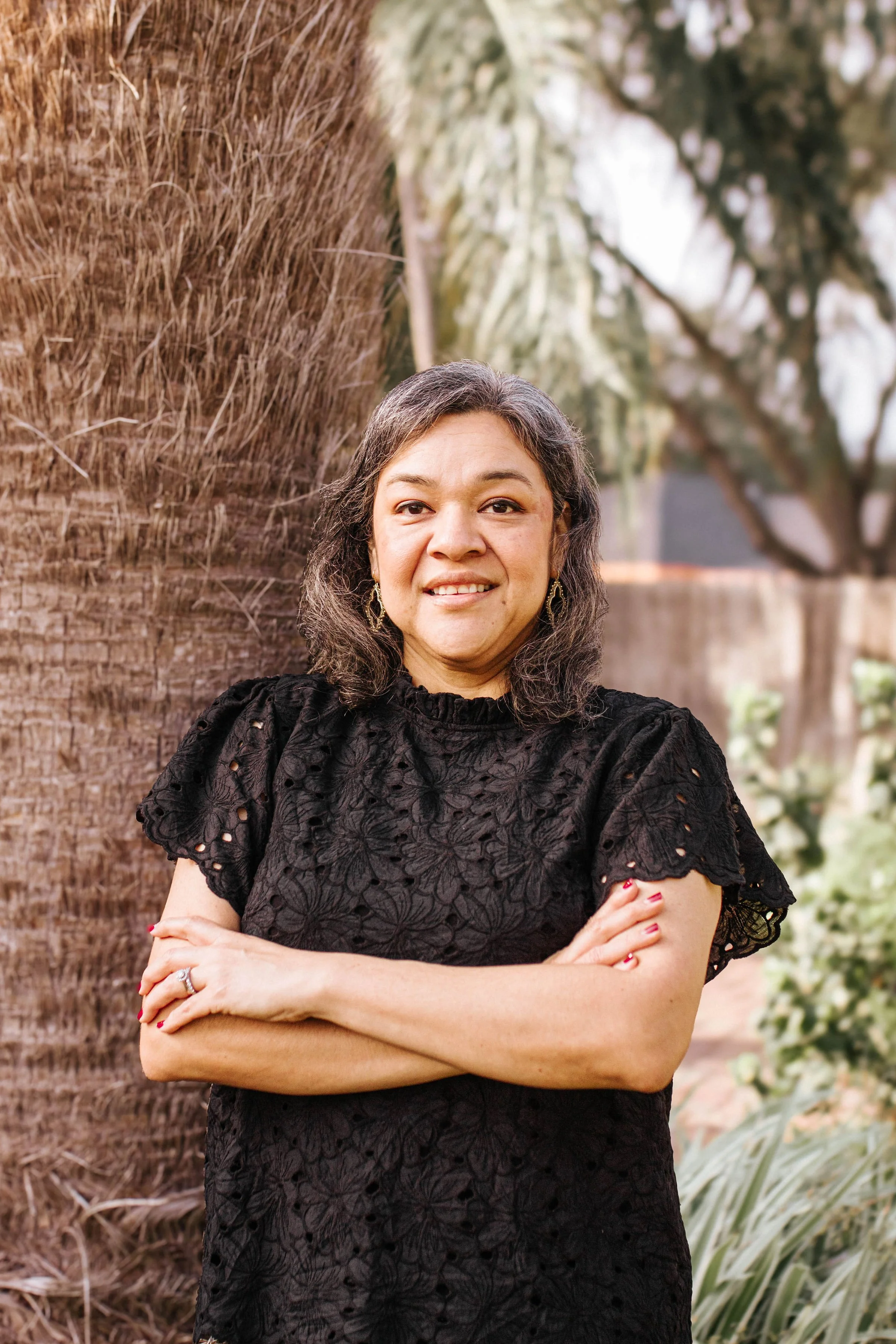
“When I think about how important this period of time that we’re in right now is, and my role as an operations professional, I want operations leaders to see themselves as the folks who can help unblock and remove obstacles for their teams.”
Amparo Herrera Hughes is still deeply rooted in the communities that nurtured her.
Raised by first-generation parents who were born in Mexico, her family put down roots in a southern Texas community in the Rio Grande Valley. Their neighborhood (colonia) consisted primarily of seasonal farmworkers.
“There were times when we were the only family living in our area because everyone else would go wherever the crops were,” she explains. “My parents made the decision early on that they were not pulling us out of school because they wanted us to get an education. My dad took on a job as a truck driver.”
Her parents had each attained a sixth-grade education, so they understood learning as the key to greater opportunities. “They told us we didn’t have to work; our job was to do well in school,” she says.
In school, Amparo did more than well. As a high school junior, she gained a mentor in one of the school’s English teachers and self-appointed college prep advisor, Francisco Guajardo. He became a personal champion and steward of opportunities—helping to connect Amparo to the world beyond South Texas but encouraging her to never forget home.
She recalls his advice: “He was trying to cultivate in kids a desire to go see the world—to leave this little neck of the woods for school and see what’s out there, but then come back because this community nurtured you.”
After moving to Austin to attend the University of Texas, Mr. Guajardo introduced Amparo to a new mentor—his brother, Miguel Guajardo, a then-PhD student at the University of Texas LBJ School of Public Affairs. Not only did Miguel serve as a touchstone to remain connected to her roots, but he also helped her secure a work-study position as an administrative assistant in his department, the Urban Issues Program.
“I learned so much there: how to use databases, how to use computer programs,” she recounts. “The administrative manager there took me under her wing and invested so much time in my growth. They took really good care of me.”
After college in Austin, Amparo and her younger sister started working for a family literacy center run by Communities In Schools, a nonprofit that provides wraparound support for students at risk of dropping out. Amparo says more than anything she learned in school, it was this role that awakened her social consciousness. Providing English as a Second Language (ESL) and GED classes for parents of children under seven, she saw clearly how those families mirrored her own.
She described driving home from work with her sister in tow, noticing how the parents commuting from the center looked like her own: “Sometimes my sister and I would be at the stop light, and we would look over and see them with their kids at the bus stop. We’d talk about how our parents really instilled in us the importance of getting an education and how that one decision opened so many doors for us. It highlighted for me that no one is less deserving or worthy of opportunity than I am. That’s when I started to understand the imbalance in our society and the world.”
That transformational experience, combined with growing her nonprofit administrative knowledge, was exactly the kind of training and education that Amparo was craving. She kept building on her administrative knowledge with a two-year stint at Catholic Charities, where she managed the internal finance operations and oversight of the administrative team.
She recounts her favorite project during her time there: “We would put on weekend trainings for the community, targeting different regions of the city. The whole goal of the project was to make immigrant communities aware of the resources available to them and to dispel the notion that, as an immigrant, you don’t have rights in this country. We wanted to bring them out of the shadows,” she recalls. “That’s how I met Workers Defense.”
The connection with Workers Defense Project was fateful. As she got to know the organization's then small staff, she fell in love with both their mission and the people. “I loved their energy, and I loved being around the members,” she shares. “It was my first introduction to community organizing. Before, I had been in the social service sector, which is very different. This felt like we were really centering the voices of the people most closely impacted. Giving the power and voice back to them was an inspiring thing to see.”
Her first official role with Workers Defense was as a part-time bookkeeper that solidified her bona fides as an accounting professional. In 2007, she left for a full-time job with Communities in Schools of Central Texas as Finance Associate, which helped her hone her nonprofit accounting and finance knowledge. But she never forgot about the sense of community she felt with Workers Defense Project, and when they put out a call for an operations manager in 2013, she jumped at the opportunity.
She joined Workers Defense for a second time at a pivotal moment, and for more than a decade, Amparo would grow professionally along with the organization. Workers Defense is a state-based organization headquartered in Austin, but they had just opened another office in Dallas. The expansion came on the heels of a couple of significant state-based policy wins.
Recounting strategy conversations from that era, she says, “We just started to think about where our members needed to have a seat at the table, and that was always the north star for the organization. How do we ensure we are creating both political and economic power for our members? What are the spaces where their voices are critical for the state to move in the right direction?”
The answer to these questions was a multi-entity strategy. Just a year and a half into her role as a manager, she became central to setting up Workers Defense Project’s first sister organization—Workers Defense Action Fund. “At that time, I wasn’t part of the leadership team. I wasn’t a director. We may not have been experts on the how, but we knew we needed to do this,” she says.
Diving into the deep end of operations and compliance during this process gave her insight into how to help staff at social justice organizations who also want to implement a multi-entity strategy from scratch. “That’s why I think a lot about how crucial it is for operational leaders to have a seat at the strategy table. It was a really important step in the trajectory of the organization.”
Two years later, she was promoted to Director of Operations and repeated the process, establishing Workers Defense In Action PAC in 2016 to campaign in support of a paid sick leave measure for Austin voters. Establishing separate entities for Workers Defense really illuminated for her how a multi-entity organization can move the needle on urgent issues.
“When we talk about multi-entity structures at NLA, I feel like I got a front row seat on how a multi-entity strategy can increase your organization’s impact and amplify your work,” she explains. “We have different vehicles at our disposal to advance our strategy in our movements; we just need to learn to use them better and bolder while remaining in compliance.”
Speaking from a place of both ardent passion and deep experience, it’s clear that Amparo’s time at Workers Defense equipped her with the experience that she uses now as New Left Accelerator’s Managing Director of Programs. She joined NLA in the summer of 2024 as the Senior Director of Capacity Building and was again promoted within a year of working with the organization. In her current role, she is dedicated to making operational and administrative processes as smooth as possible for staff at social justice organizations.
“When I think about how important this period of time that we're in right now is, and my role as an operations professional, I want operations leaders to see themselves as the folks who can help unblock and remove obstacles for their teams,” she explains. “You have to understand all of the pieces, not just for one legal entity, but for all of them, and the different avenues available to you. I think that’s critical for our movement right now.”
Because it’s so critical, Amparo has dedicated much of her time at NLA to helping to clarify those moving pieces for organizational leaders who are facing multiple issues in the social justice landscape. For example, under her implementation in 2025, NLA introduced a new training series, Bold & Safe, to teach organizations about emerging challenges in the field related to digital security, risk management, and overall adaptive capacity. Now is the time for organizations to be curious about how they can do things differently, and Amparo and her team are on standby to answer many of those questions.
Helping social justice organizations build sustainable operations frameworks is highly technical, but Amparo grounds her work in her love for the communities that poured into her, especially with so many social and political crises brewing. Now living back in her hometown while working with organizations on the frontlines to protect politically vulnerable groups across the city, state, and country, she reflects on the throughline of her professional roles.
“It goes back to me being a 19-year-old-kid working at a family literacy center, seeing parents who wanted to learn English, so they could help their kids with their homework. I care very deeply about my community. That’s why I do this work. When I look around, I don’t just see random people getting kidnapped by ICE. I see my family,” she said tearfully before reiterating, “There’s no difference between us.”
